Executive Summary
Small business owners across the United States approached 2025 with persistence, caution
and a deep sense of responsibility to the people who depend on them. Throughout the year,
Revenued conducted multiple research studies, including the AI Usage Study, Q3 Tariff Report,
Tariff Ripple Report and our final Year-End Resilience Survey, to understand how small
businesses navigated economic volatility, shifting customer demand and tightening credit
conditions.
Taken together, these studies reveal that 2025 was defined not only by uncertainty, but by a
steady, practical resilience. Owners adjusted continually and quietly, making incremental
changes that kept many businesses operating through what they described as one of the most
unpredictable years in recent memory.
Core Themes From 2025
• Volatility shaped the year, with unpredictable revenue patterns, supplier delays and fluctuating demand.
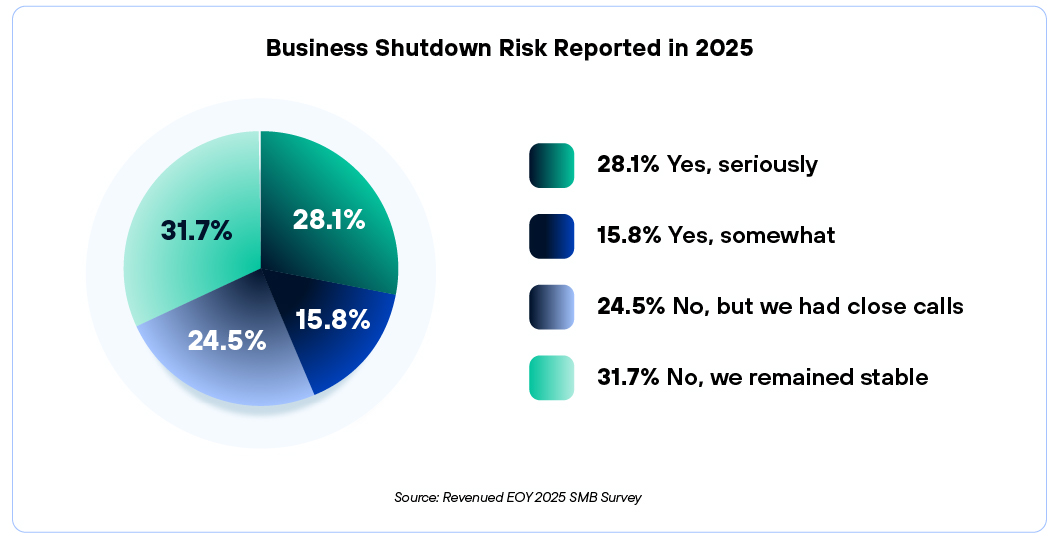
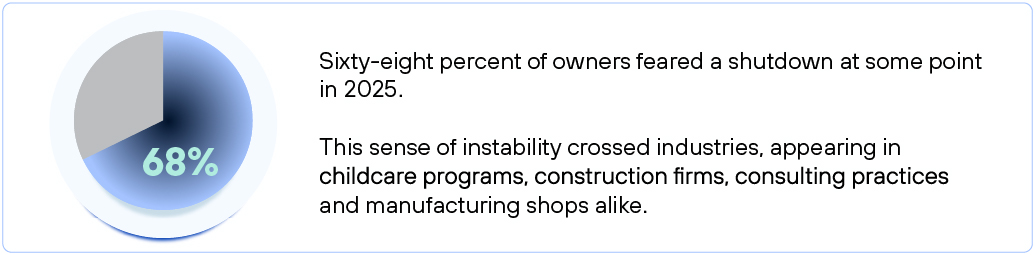
• Financial pressure intensified, with 68 percent of owners reporting at least one moment
when they feared their business might not make it.
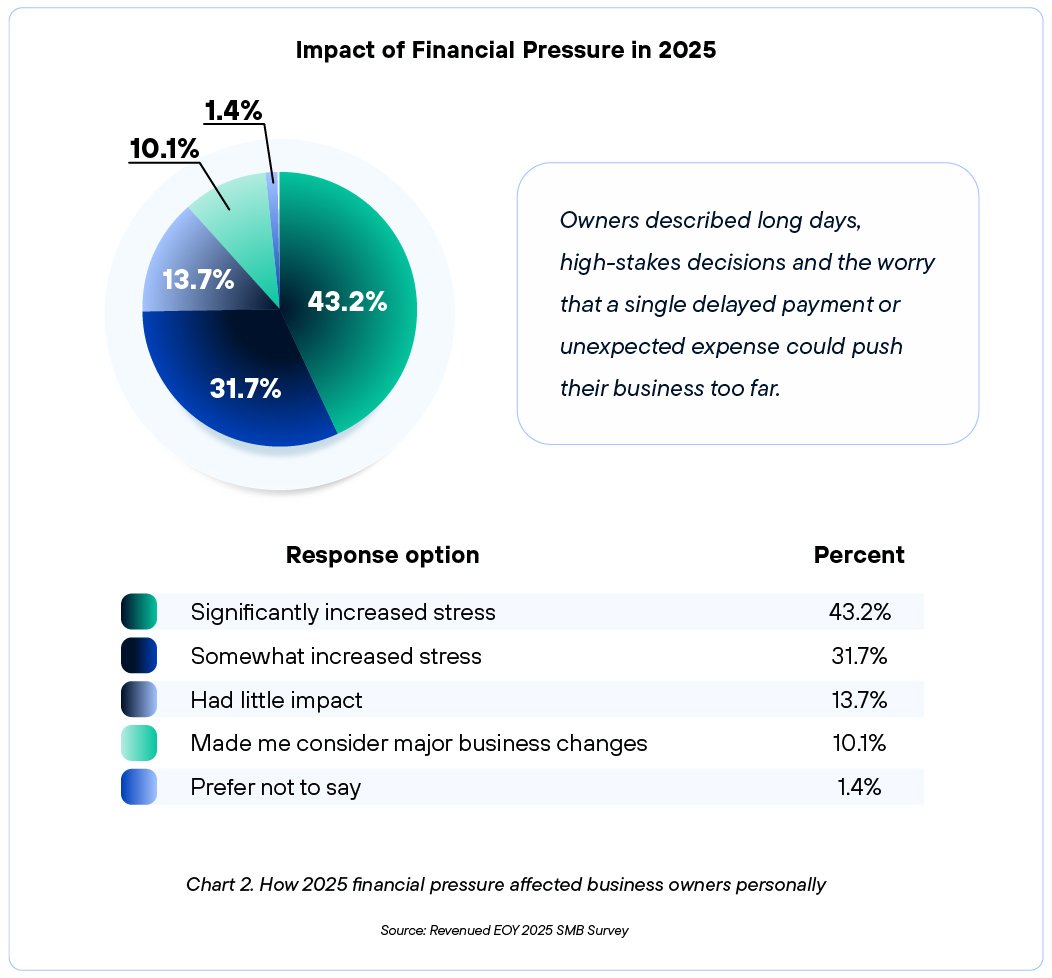
• Stress levels rose, with 43 percent saying financial pressure significantly increased their
personal stress.
• Operational adaptability became essential, from workflow redesigns to scaled-down
service offerings.
• Traditional financing often fell short, prompting many owners to look for faster and more
flexible alternatives.
• By year’s end, owners described themselves as more experienced, more grounded and
more prepared for whatever comes next.
Key Findings From the 2025 Year-EndSurvey
The Revenued Year-End Survey revealed a landscape marked by strain, adaptation and
determination. Volatility reached across industries, yet owners responded in ways that revealed
consistent patterns in both the numbers and the lived experiences behind them.
1. Financial Pressure Defined the Year
More than two-thirds of small business owners experienced at least one point in 2025 when
they feared their business might not survive.
2. Stress Levels Reached New Highs
Financial strain carried a personal cost.
• Forty-three percent of owners said financial pressure significantly increased their stress.
• Another third said it somewhat increased their stress.
Most owners experienced elevated strain.
3. Adaptability Became a Survival Strategy
Owners embraced small, frequent adjustments rather than dramatic overhauls. The goal was to
reduce unpredictability, protect cash flow and maintain customer trust.
Adjustments included:
• Restructuring service tiers
• Renegotiating supplier contracts
• Reducing operating hours or consolidating staff
• Using AI tools for administrative work
• Changing payment terms to stabilize cash flow
Many said financial pressure forced them to rethink how their business operated, whether
through pricing, workflows or cost structures.
4. Traditional Financing Fell Short
Owners frequently described a widening gap between the support they needed and what
banks delivered.
They pointed to:
• Approval timelines that clashed with urgent needs
• Qualification criteria that did not reflect volatile revenue
• Rigid repayment structures
• Financial tools designed for stability rather than real-world volatility
Angela, a renovation business owner in Virginia, said access to flexible funding “made the
hardest months survivable.”
A significant share of respondents reported turning to alternative financing at some point this
year, including revenue-based financing and other flexible options that aligned more closely
with their cash flow.
5. Resilience Strengthened Over Time
Despite ongoing pressure, many owners described entering 2026 with a grounded sense of
confidence. They said they were better prepared, had a clearer sense of what their businesses
could withstand and felt their experience, rather than market conditions, was carrying them
forward.
The Strain Beneath the Surface
Throughout 2025, owners from every industry described similar challenges, even if the
circumstances differed.
Tanya, who owns Little Steps Learning Center in Illinois, said she “felt the floor move more
than once” as enrollment shifted from week to week. Maya, founder of Orange Grove Creative
in Florida, said each month felt like “a different economy,” which made it difficult to plan ahead.
Omar, who operates Red Rock Construction in Arizona, described rewriting bids nearly every
week because supplier prices were changing faster than his team could adjust.
These individual accounts mirrored the broader dataset. Many owners reported moments of
genuine fear about their business’s future, and most said the financial strain of 2025 increased
their stress. Owners described long days, high-stakes decisions and the constant worry that a
single delayed payment or unexpected expense could push their business too far.
How Businesses Adapted When Conditions Kept Changing
Resilience in 2025 rarely looked dramatic. It looked quiet. It looked incremental. It looked like
owners making small adjustments that, taken together, kept their businesses open.
Renee, owner of Piedmont Custom Manufacturing in North Carolina, redesigned her workflow
to account for shipping delays and tariff-related price swings. “We stopped assuming
anything would arrive on time,” she said.
Angela, who owns Tidewater Renovation and Design in Virginia, created a smaller service tier
for customers who were nervous about committing to larger projects. The offering did not
increase revenue immediately, but it kept her business active during unpredictable stretches.
Marcus, who runs Lakeside Auto Service in Michigan, renegotiated supplier contracts,
updated his pricing structure and made changes that helped protect his cash flow. “I needed
something that matched how my business actually runs,” he said.
Many owners also turned to technology. Some adopted AI tools to complete time-consuming
administrative tasks. Others relied on digital invoicing, scheduling platforms and automated
customer-communication systems to reduce the burden on already stretched teams.
These adjustments varied, but they shared a purpose. Owners were trying to bring stability to
systems that no longer behaved predictably.
The Limits of Traditional Support and the Search for Flexibility
One of the clearest findings of the year was the widening gap between what owners needed
and what traditional financing provided.
Owners often pointed to approval timelines that were too slow, criteria that failed to reflect
real-world revenue patterns and repayment structures that did not adjust when business
softened. Several described bank tools that felt designed for a steady environment, not for the
shifting landscape they operated in.
A significant number of survey respondents reported turning to nontraditional or flexible
financing options during the year, including revenue-based financing that aligned with cash
flow rather than fixed monthly payments.
Angela, the renovation owner in Virginia, said this flexibility “made the hardest months
survivable.”
Jake Lerner, Chief Revenue Officer at Revenued, saw the trend across industries. “The
businesses we spoke with were not looking for special exceptions,” he said. “They were
looking for financial tools that reflect how their businesses actually work.”
The Human Perspective From Interviews
Survey data revealed the scale of small business challenges in 2025. Interviews revealed their
emotional depth.
Elona Bregasi, who led many of these conversations, said owners often spoke about
exhaustion, but her strongest impression was their sense of responsibility. “They described
showing up for their teams, their customers and their families, even when things were
difficult,” she said. “There was a determination that did not always show up in the numbers,
but it came through clearly in their voices.”
This human dimension helps explain why many owners said they felt more prepared for 2026,
even though most expected another challenging year. They were not becoming more
optimistic. They were becoming more experienced.
When asked about the new year, owners did not describe optimism. They described
perspective.
Tanya, the childcare provider in Illinois, said she now understands what her business can
withstand. Maya, the marketing consultant in Florida, said she enters 2026 “more realistic but
more confident.” Others echoed the same mix of caution and earned clarity.
Grant Pastor, Director of Marketing and Research at Revenued, saw the same pattern
reflected in the data. “What stood out most was the resolve,” he said. “People were pushed
into difficult situations and still found ways to move forward. This was not blind positivity. It was
confidence shaped by experience.”
These insights set the tone for how owners are approaching 2026.
How Owners Are Approaching 2026
The final phase of Revenued’s Year in Review research asked business owners how the close
of 2025 was shaping their expectations for the year ahead. Their responses revealed a
community that feels stretched, resourceful and increasingly practiced in navigating volatility.
1. Financial Pressure Carried Into the New Year
Many owners said financial pressure increased as 2025 ended, citing rising costs, inconsistent
demand and slower payments. Only a small number reported any relief.
"Many owners said financial pressure increased heading into 2026. This finding reinforces a broader theme: the unpredictability of 2025 did not fade toward year-end. It accumulated."
2. Cash Flow Is the Central Concern for 2026
When owners identified their biggest challenge for the year ahead, cash flow dominated.
Owners described:
• unpredictable payment cycles
• tighter access to capital
• rising supplier and operating costs
• difficulty building reserve funds
• uneven seasonal or regional demand
“Cash flow became the whole game this year,” said Jordan, who runs a retail business in Ohio.
Other concerns included customer demand, labor costs and inflation, but none appeared as
frequently as cash flow.
3. More Owners Turned to Tools and AI for Efficiency
The adoption of new tools and technology increased throughout the year. Owners said this
shift was driven by necessity rather than curiosity.
Examples included:
• automated scheduling
• invoicing and payment reminders
• AI assistants for paperwork and communication
• inventory tracking
• follow-up tools for customers
Many respondents said these tools helped them manage time more effectively, and several
indicated that they will play a larger role in 2026.
4. Despite the Pressure, Many Owners Feel Prepared for 2026
Most respondents described themselves as at least somewhat prepared for 2026. That
preparedness did not come from improved conditions, but from the adjustments they made
throughout the year.
Several owners said they now have a more realistic understanding of what their business can
handle, even if they expect another difficult year.

Owner Profiles From the 2025 Year in Review
Jordan (Retail, Ohio)
“Cash flow became the whole game this year.”
Jordan described erratic customer behavior and rising supplier costs that made planning nearly impossible. He enters 2026 focused on building a more consistent cash buffer.
Celeste (Consulting, California)
Celeste described unpredictable client payments and a growing administrative workload. She turned to digital tools to stay organized and said she feels “prepared but watchful” heading into the new year.
Malik (Transportation, Georgia)
Malik pointed to increased fuel and maintenance costs, paired with late payments. He adopted new invoicing and scheduling tools and expects 2026 to be demanding but manageable.
Denise (Hospitality, Pennsylvania)
Denise saw fluctuating customer demand and staffing challenges throughout the year. Rising food and supply costs narrowed her margins. She remains cautiously optimistic but expects pressure to continue.
What 2025 Taught Small Business Owners
The final responses of 2025 reveal a small business community entering the new year with realism and earned confidence. Owners expect unpredictability. They anticipate financial
pressure. They do not count on sudden demand stability. Yet many feel ready to navigate what
comes next.
They said:
• they now understand what their businesses can withstand
• they plan to rely on the adjustments they made in 2025
• flexibility and speed will matter more than long-range planning
• they expect swings in demand and cost to continue
“I am not expecting next year to be easier. I am just more prepared for how hard it might be,”
said Denise, the hospitality owner from Pennsylvania.
Cash flow will continue to shape strategy. Technology will continue to save time. Traditional
financing gaps will matter. And resilience will remain the mindset that defines small business
operations in 2026.
A large share of respondents described themselves as prepared for the new year.
Preparedness does not necessarily reflect optimism. It reflects confidence shaped by
experience.
Many owners said they are entering 2026 more prepared than ever
Editor’s Note
This report draws on research surveys and interviews conducted throughout 2025 by the
Revenued team, led by Grant Pastor and Elona Bregasi. Some names and identifying details
have been changed to protect privacy. Quotes have been lightly edited for clarity.
Resilience in Action: What 2025 Taught America’s Small Business Owner