Key Findings At a Glance
• 50.8% of business owners surveyed are under 45, this age group is among the most likely to have no exit timeline at all
• Longer tenure does not produce more planning: owners at the 6 to 10 year mark have the highest rate of having identified a successor (62.2%), while owners with 10+ years have the lowest (40.5%)
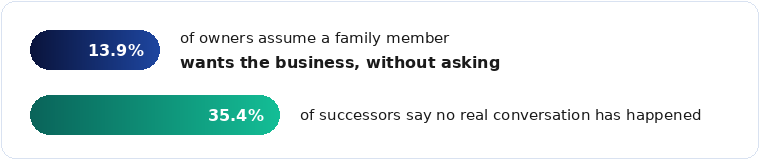
• 13.9% of owners assume a family member wants the business without ever directly asking; 35.4% of next-gen respondents say no real conversation has taken place
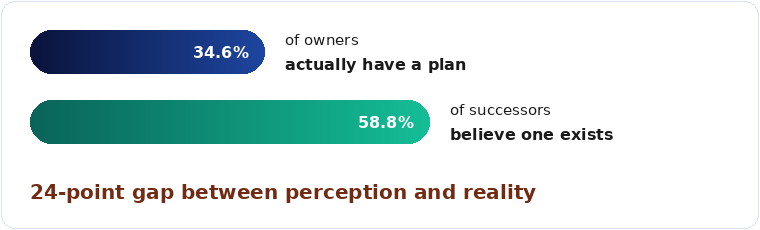
• Only 34.6% of owners have any succession plan in place, yet 58.8% of next-gen respondents assume one already exists: a 24-point perception gap and the central finding of this report
• Owners are anchored in what they'll lose, financial security, daily purpose, identity, while 25.6% of next-gen respondents already see taking over as an obligation rather than an opportunity
Executive Summary
Small business succession in America is stalling. Not because owners and their potential successors are in conflict, but because both sides are operating on assumptions the other side doesn't share.
Owners assume their families want the business. Successors assume a plan already exists. Neither is asking. Neither is documenting. And the silence is being read, on both sides, as a signal that everything is under control.
That's the central finding of this report. Revenued fielded two parallel surveys in May 2026, one of 130 small business owners, one of 274 potential successors with a family member who owns an active business. Together, the data shows a succession system failing at the human layer before it ever reaches the financial one.
This report presents findings across five areas: exit timelines by age, tenure and succession readiness, the assumption gap, the perception gap, and the industry and emotional dimensions of exit. Verbatim responses from survey participants are included throughout to illustrate the human dimensions behind the data.
Methodology
This report is based on two surveys conducted by Revenued in May 2026. Survey A was distributed to 130 small business owners. Survey B was distributed to 274 adults with a close family member who currently owns an active small business.
Both surveys were administered online via Prolific. Respondents received a gift card incentive of $15 to $25 for participation. Survey A respondents passed a four-question screener confirming active ownership, at least three years in business, primary decision-making authority, and a workforce under 100 employees. Survey B respondents confirmed their family member's business is actively operating and that the owner is 50 or older.
Quality controls applied to both surveys included an embedded attention check, a minimum completion time threshold, and a consistency flag for contradictory answers; respondents triggering these flags were excluded. All percentages are rounded to the nearest whole number. Because the two surveys draw from separate respondent pools rather than matched family pairs, the comparisons in this report describe gaps between groups, not disagreements within individual families.
Respondent Profile
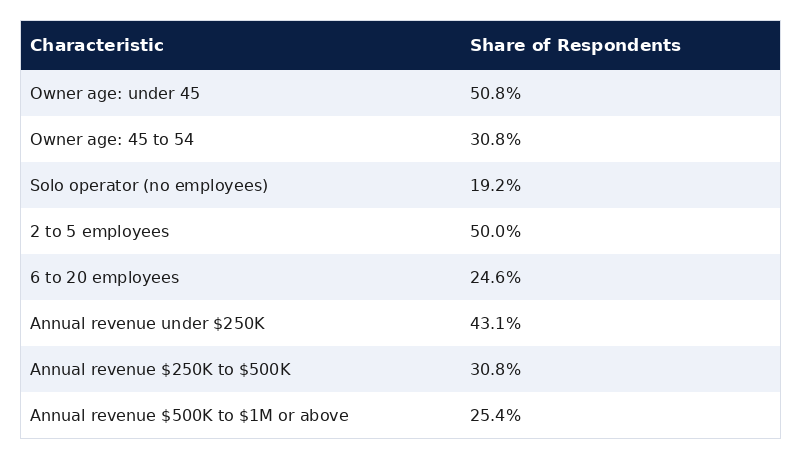
Survey A skewed toward younger, active owners still in the mid-phase of their business lifecycle. Just over half (50.8%) are under 45, and another 30.8% fall between 45 and 54. Business size skewed small: 19.2% are sole operators, 50.0% employ 2 to 5 people, and 24.6% employ 6 to 20. Revenue followed a similar pattern, with 43.1% under $250K in annual revenue, 30.8% between $250K and $500K, and 25.4% at $500K or above. Survey B captured a range of family relationships, all connected to business owners aged 50 and older. That age threshold reflects the window in which succession planning typically becomes a live decision rather than a hypothetical one.
Section 1: Exit Timelines by Age
Owners under 45 make up 50.8% of the survey sample, and they're among the most likely to have no exit timeline at all, 25.8% say they simply don't have one, more than double the 12.5% rate among owners aged 65 to 74. (The 55 to 64 group shows a slightly higher rate still, 30.8%, though on a much smaller sample of 13 respondents.) It's not that younger owners have decided to stay forever, it's that they haven't landed on an age, a milestone, or a plan yet. For many, retirement still feels far enough away that naming a date seems premature.

What's Changed In The Last Three Years
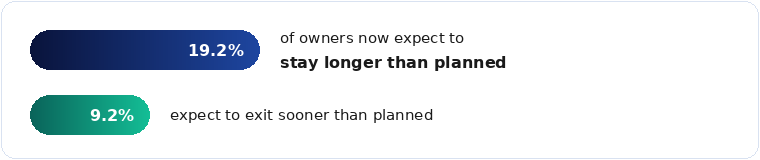
Most owners say their exit timeline hasn't moved, 46.9% report it's stayed roughly the same as what they expected three years ago. But among those whose plans have shifted, the direction tells its own story: owners are more likely to be extending their timeline than accelerating it. Nearly one in five (19.2%) now expect to stay in the business longer than they'd originally planned, while less than half that share, 9.2%, have moved their exit date earlier. That imbalance suggests the pressures pushing owners to stay are stronger right now than any pull toward an earlier exit.
Why Owners Are Staying Longer
Among the 19.2% of owners who've pushed their exit later, the reasons cluster around money, not motivation. 28.0% cite more financial pressure on the business than they expected, and another 24.0% point specifically to rising costs in fuel, labor, and materials. Financial strain, not runaway success, is the more common driver behind owners staying longer than planned. For this group, staying longer isn't a choice to keep building, it's a delay forced by conditions outside their control.

Section 2: Tenure and Succession Readiness
A natural assumption is that owners who've been in business longer are better prepared to hand it off. The data says otherwise: succession readiness peaks in the middle of a business's life, then declines the longer an owner stays at the helm.

The 6 to 10 Year Peak
Owners in this window are the most likely of any tenure group to have someone in mind to take over, 62.2% have identified a successor, compared with 51.8% of owners just a few years into the business. This is the stage where the business has proven itself but the owner hasn't yet settled into running it solo indefinitely. It's a narrow window, and one that closes faster than most owners expect: by the time a business crosses the decade mark, that readiness has already started to erode. For owners in this middle stretch, the practical takeaway is to treat succession planning as something to act on now, while the business still feels new enough to imagine someone else running it, rather than something to revisit once things settle down.
The Experience Paradox
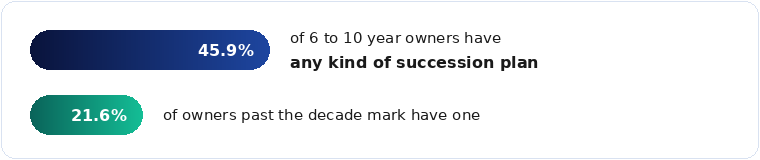
Owners with more than a decade in business are, paradoxically, the least prepared. Only 40.5% have identified a successor, the lowest of any tenure group, and just 21.6% have any kind of succession plan in place. The longer someone has run the business, the harder it becomes to imagine someone else running it. What looks like stability from the outside can mean the opposite internally: an owner who has become so central to the business that planning for their absence feels almost impossible.
What Separates them
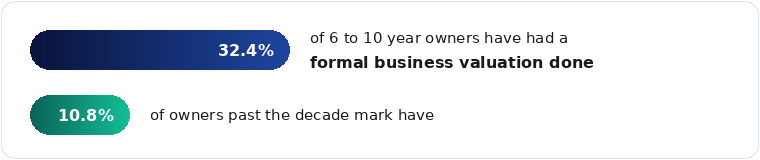
The gap isn't just about having a successor in mind, it shows up in concrete planning steps too. 32.4% of 6-to-10-year owners have had a formal business valuation done in the last three years, compared with just 10.8% of owners past the decade mark. Tenure alone doesn't build readiness, at some point it starts working against it. This points to a practical takeaway: succession planning works better as a scheduled milestone tied to the business's stage, not something owners wait to feel ready for.
Section 3: The Assumption Gap
Many owners believe a family member wants the business, without ever having directly asked. Meanwhile, next-gen respondents describe a much quieter reality, one where the conversation simply hasn't happened yet.
What Owners Assume
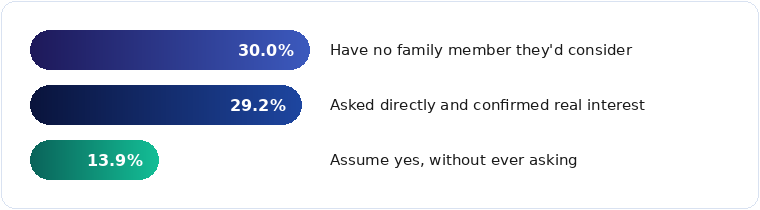
13.9% of owners say they've never asked a family member whether they want the business, they just assume the answer is yes. Another 30.0% say the question doesn't even apply, they have no family member they'd consider. Only 29.2% have asked directly and confirmed real interest. In practice, that means nearly half of all owners are either operating on an unconfirmed assumption or have already ruled family succession out, leaving little room for a plan built on real information.
What Successors Actually Say
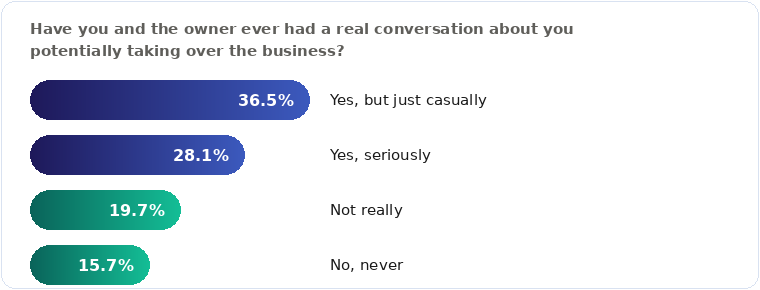
On the other side, 35.4% of next-gen respondents say no real conversation, casual or serious, has ever taken place. Raising the topic directly changes the trajectory: the conversation isn't a threat, it's the starting point neither side wants to be the one to raise. Both generations appear to be waiting for the other to open the door.
Section 4: The Perception Gap
This is the central finding of the report. What owners actually have and what successors believe exists are two very different pictures, and the 24-point gap between them means neither side is acting with accurate information.
What Owners Have
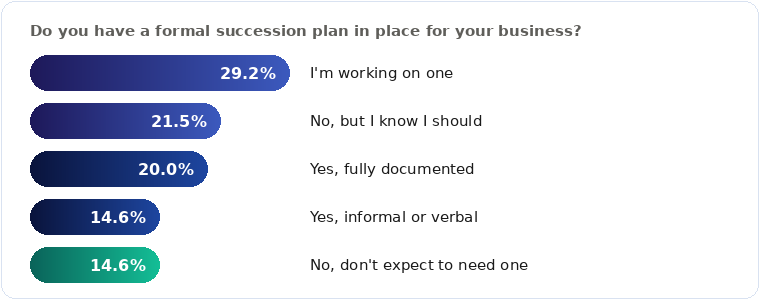
Only 34.6% of owners have any succession plan, formal or informal. 29.2% say they're still working on one, 21.5% know they should but haven't started, and 14.6% say they don't expect to need one anytime soon.
What Successors Believe
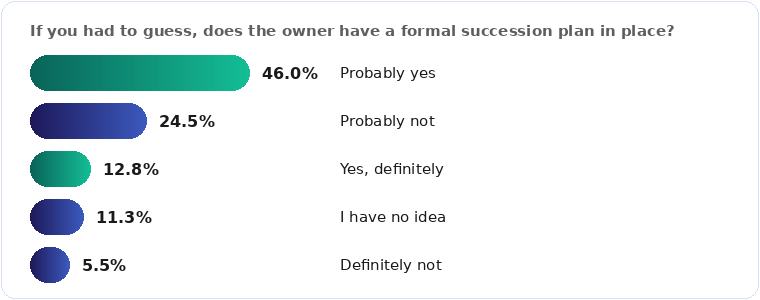
58.8% of next-gen respondents believe a plan probably or definitely exists, far more optimistic than reality supports. Only 11.3% admit they have no idea either way, most have simply assumed the best.
Closing The Gap
The fix isn't complicated: even an informal written summary of intent, who you plan to hand to, on what terms, and on what timeline, closes most of this gap. Silence is being mistaken for a plan on one side and mistaken for stability on the other.
Survey respondent
"Seeing clear, honest financials, knowing what I'm actually taking on."
Survey respondent
"I would need to have a clear understanding of the financials, a structured transition plan, and the confidence that I could lead the business without risking the family relationship."
Survey respondent
"A clear financial outlook for the business. How much debt is the business in, and can the business still be profitable in this economy."
Section 5: Industry, Financing, and the Emotional Toll
Financial barriers to exit vary sharply by industry, and awareness of financing options doesn't appear to close that gap. The final divide between owners and successors isn't financial at all, it's emotional.
Which Industries Feel It Most
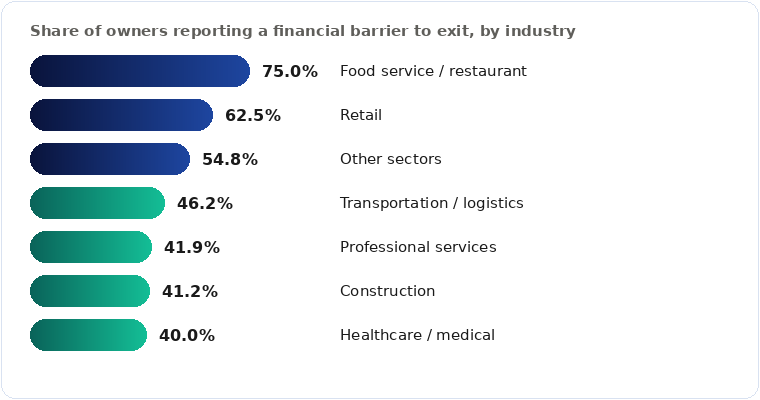
Food service is the most financially constrained sector, with three in four owners (75.0%) saying finances are limiting their exit. Healthcare, at 40.0%, is the least financially stuck among the named sectors, roughly 35 points lower. The gap likely comes down to margins and asset type: food service businesses tend to run thin margins with few hard assets to borrow against, while healthcare practices generally carry steadier cash flow and more bankable equity, making it easier to find financing on the way out. Retail and transportation fall in between, both well above the healthcare and construction end of the range, suggesting the divide isn't a single outlier so much as a spectrum tied to how capital-intensive and cash-stable a business is to begin with.
Awareness Without Access

Owners who've fully researched financing options (52.8%) are just as likely to feel financially stuck as owners who've barely heard of them (54.0%). The barrier is structural, not informational, knowing the options exist doesn't unlock them.
What Owners Fear Losing
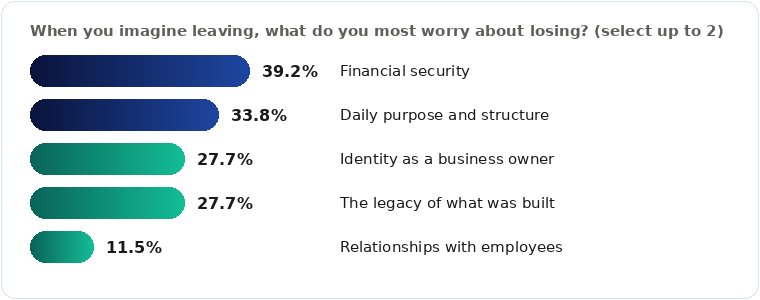
Owners are primarily anchored in what they'll lose when they leave. 39.2% point to financial security, 33.8% to daily purpose and structure, and 27.7% each to identity and legacy.
Survey respondent
Survey respondent
Survey respondent
Opportunity or obligation
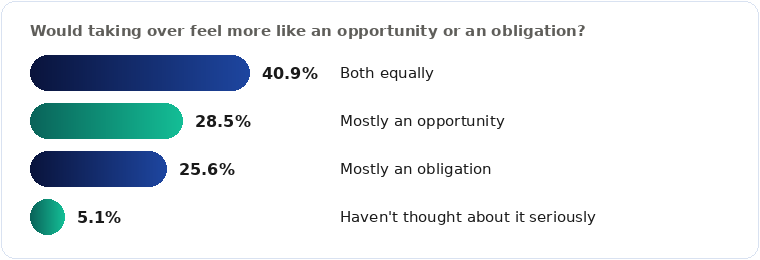
Next-gen respondents are already carrying the weight of what taking over would cost them. 25.6% see it as mostly an obligation, while 40.9% say it feels like both an opportunity and an obligation equally. Neither generation's fear is irrational, but both remain largely unspoken.
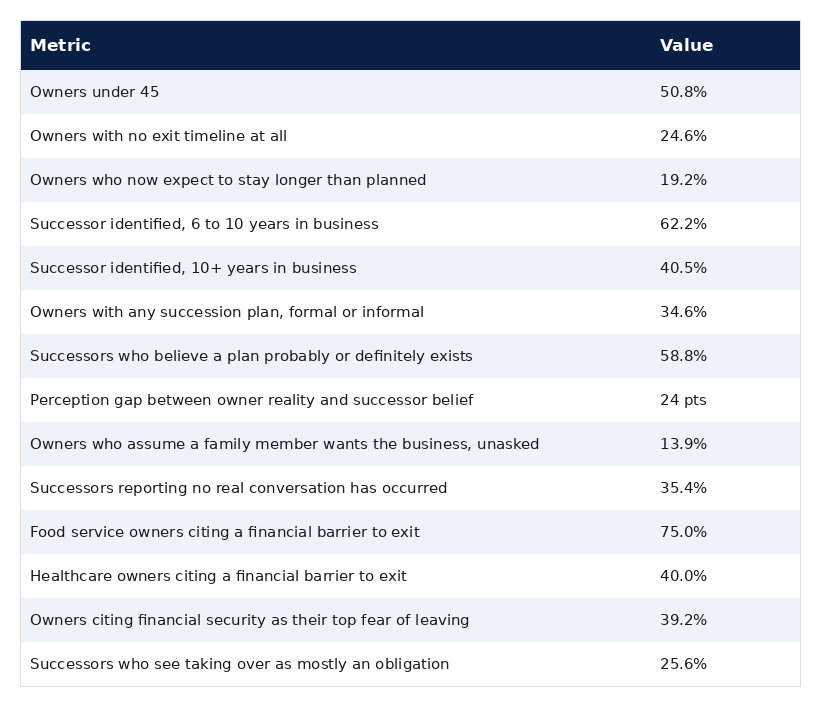
Summary Statistics
The figures below consolidate the primary quantitative findings from the 2026 SMB Succession Report. All figures reflect the combined respondent pool (130 owners, 274 next-gen) unless otherwise noted.
FOR PRESS AND MEDIA INQUIRIES
Revenued Research publishes quarterly data reports on the economic health and outlook of U.S. small businesses. Reporters and editors may cite data from this report with attribution to Revenued.
Full reports and data available at: revenued.com/small-business-reports
Press contact: press@revenued.com
Who Takes the Keys? The State of Small Business Succession in America.
Only 34.6% of Small Business Owners Have Any Succession Plan in Place, New Revenued Survey Finds. Report of 130 owners and 274 potential successors reveals a 24-point perception gap, a widening assumption gap, and a succession system stalling at the human layer before it ever reaches the financial one.